
How to prepare your CX ops for BFCM (and every peak season after it)
Working alongside some of the world’s most successful ecommerce brands through BFCM has given us a pretty good view of what great peak season preparation looks like. Again and again, we’ve seen them turn huge spikes in demand into success without letting the customer experience fall apart. More importantly, it’s shown us just how much of that success is decided months before Black Friday arrives.
Every year, plenty of businesses promise themselves they'll start earlier, and every year, peak season arrives a little too quickly anyway.
By then, the marketing calendar is locked in, hiring is already behind schedule, documentation updates keep getting pushed to "next sprint," and everyone is hoping the operation they've got today magically transforms into the operation they need in November.
Sometimes it works; more often, it doesn’t. Peak season has a way of exposing every operational shortcut a business has been getting away with. Processes that felt perfectly adequate in July very suddenly start showing huge cracks.
That's why BFCM preparation should be treated as a three-month operational project at least. By the time peak season arrives, the focus should be on execution rather than scrambling to put the pieces in place.
This playbook walks through exactly how to properly prepare; not just what happens in the weeks before Black Friday and Cyber Monday, but the operational decisions that make it all feel controlled instead of chaotic.
While the examples throughout focus on BFCM, the same framework applies to every period of increased demand. Holiday shopping, back-to-school, Mother's Day, tax season, product launches… you name it. Remember: peak seasons change; good operational preparation doesn't.
Before you build the timeline, build the foundation
The biggest mistake companies make during peak season is treating it like a customer support problem instead of an operational one. Hiring too late, forgetting to update FAQs, or relying too heavily on automation are all common mistakes, but they're symptoms rather than the root cause.
Assuming peak season is mostly about handling more customer conversations is a trap that we see experienced operators fall into time and time again. It's actually about making sure customers never need to start many of those conversations in the first place. Every improvement you make before volume arrives compounds once it does:
- Clearer shipping information creates fewer "Where's my order?" tickets.
- Better routing reduces unnecessary transfers.
- Updated documentation improves both self-service and AI responses.
- Better forecasting leads to better staffing.
- Stronger escalation paths keep small problems from becoming expensive ones.
By the time Black Friday actually arrives, every improvement you've made should already be working in your favor, not still waiting to be finished.
The six pillars of peak season readiness
Every successful peak season preparation plan, regardless of company size or industry, comes back to the same six operational areas.
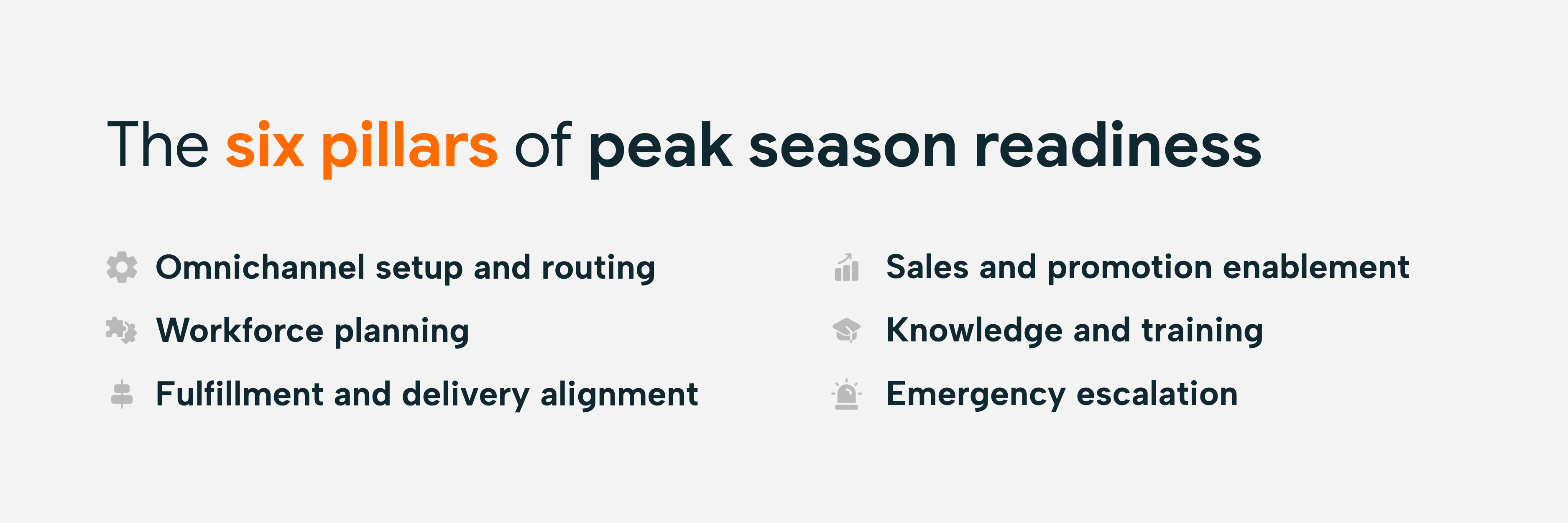
None of them work in isolation; weakness in one usually creates more work somewhere else.
1. Omnichannel setup and routing
Peak season is a terrible time to discover your support queues aren't prioritizing the right work.
Once a quarter, whether or not you're expecting a volume increase, review how customers enter your support operation, how conversations are routed, and whether urgent issues actually reach the people who can solve them fastest.
This is also the time to review queue priorities across all your channels: SLAs, chatbot entry points, IVR menus, and any automated routing rules that determine where conversations go. The smoother the routing, the less work your team creates for itself.
2. Workforce planning
Most hiring decisions happen too late, and unfortunately, new team members don't become productive overnight. Recruiting, onboarding, training, calibration, and nesting all take time, which means capacity decisions should be made months before customers notice you needed them.
Forecast expected demand using historical volume, promotional calendars, marketing plans, new product launches, and any operational changes that could influence contact rates.
Whether that's a spreadsheet, a dedicated forecasting tool, or even a whiteboard session with the right stakeholders is less important than taking the time to do it.
Then compare that forecast against the team you'll actually have. If there's a gap, finding it in August is planning; finding it in November forces improvisation.
3. Fulfillment and delivery alignment
Support teams rarely create shipping problems, but they sure do spend a lot of time explaining them. Strong communication between customer support, fulfillment partners, warehouses, logistics providers, and ecommerce teams dramatically reduces confusion during peak season.
Review and document escalation paths, tracking visibility, delivery exception handling, shipping cutoff communication, and return policies before customers start asking about them. The fewer surprises your support team receives, the fewer surprises your customers experience.
4. Sales and promotion enablement
The biggest spikes in support volume often come from pure confusion.
Customers aren't just trying to “place orders” during BFCM. They're trying to understand discount rules, shipping deadlines, bundle offers, gift cards, loyalty rewards, subscription changes, inventory availability, return windows, and whatever marketing announced on social media thirty seconds ago.
Your support team should never be learning about a promotion from a customer. Before peak season begins, make sure everyone supporting customers understands:
- Every live promotion and offer
- Start and end dates
- Exclusions and eligibility requirements
- Expected contact drivers
- Inventory limitations
- Any changes to shipping or returns
… and that it’s all properly documented. The more training and context your team has before launch, the more confidently they can help customers when questions inevitably arrive.
5. Knowledge and training
Documentation doesn't just improve consistency across your team; it also reduces onboarding time, improves self-service, strengthens AI performance, and gives new team members somewhere reliable to look before asking someone else.
Every customer question that could have been answered without contacting support is one less conversation your team needs to have.
Peak season exposes documentation that's drifted out of date over the rest of the year, whether it’s old screenshots, expired policies, missing shipping information, or help articles that made perfect sense before your website was redesigned two product launches ago.
That's why documentation isn't something you update the week before Black Friday. Review your:
- Help Center and FAQs
- Internal knowledge base
- Macros and saved replies
- AI knowledge sources
- Onboarding materials
- Escalation documentation
Then ask yourself, “If someone joined our team tomorrow, could they confidently support customers using only what's documented?” If the answer is no, neither can your AI.
6. Emergency escalation
No operation is perfect: systems go down, payment gateways fail, warehouses lose visibility, carriers experience delays. Peak season isn't the time to decide how you'll respond when something unexpected happens. Build those decisions ahead of time.
Define who owns incident communication, how information flows between departments, where updates are shared internally, and what customers should hear while the issue is being resolved.
Pre-write status page updates, email templates, live chat responses, and social messaging for the scenarios you hope never happen. You may never need them, but if you do, you'll be glad the words already exist. The goal isn't to eliminate every incident; it's to eliminate the chaos that often follows one.

The 12-week roadmap
Every successful BFCM starts long before customers begin shopping. You won’t be scrambling in November if you finish most of the difficult work in August and September.
Think of the twelve weeks before peak season as three distinct phases; each one builds on the last. Miss one, and the next becomes significantly harder.
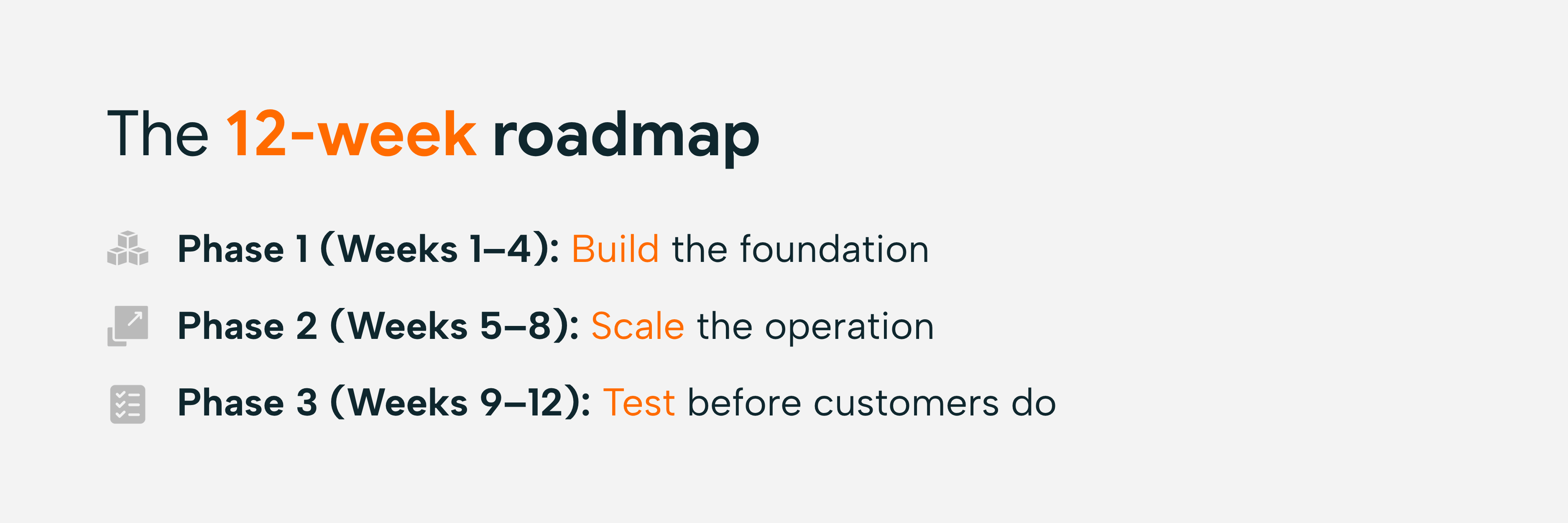
Phase 1 (Weeks 1–4): Build the foundation
The first month is less about moving quickly and more about making sure you're moving in the right direction to begin with. Before you think about hiring, automation, or stress testing, you need a clear understanding of the whole operation you're preparing.
Start by reviewing your current support environment:
- How are conversations routed today?
- Which channels generate the highest volume?
- Where do customers get stuck?
- Are your integrations, fulfillment systems, and reporting giving you accurate information?
This is also the right time to forecast expected demand using last year's performance, planned promotions, product launches, and any business changes that could influence customer behavior. From there, shift your attention to the knowledge your operation depends on.
- Update public FAQs.
- Review internal documentation.
- Refresh macros.
- Confirm your shipping, return, and promotional policies reflect what customers will actually experience during peak season.
Every document you improve today is one less question your team has to answer later.
What success looks like for phase 1
By the end of this phase, you should have:
- A realistic demand forecast
- Clear visibility into operational risks
- Current customer-facing documentation
- Refreshed internal knowledge
- Agreed priorities for the rest of the preparation period
The foundation isn't particularly exciting, but it’s also the part that's hardest to recover from if you skip it.
Phase 2 (Weeks 5–8): Scale the operation
Once the foundation is in place, it's time to prepare the operation for higher demand. This is where many businesses jump straight to only hiring, while in reality, additional headcount is only one piece of the puzzle.
Peak season puts pressure on every part of the customer journey. If your systems, processes, and documentation aren't ready, adding more people just means more people navigating the same operational bottlenecks.
This phase is about giving your team the tools, context, and processes they'll need before volume starts climbing. Here are the areas to focus on:
- Prepare your automation
- Build capacity before you need it
- Align with the teams behind the experience
Let’s look at all of these in more detail.
Prepare your automation
Automation works best when it reduces repetitive work, not when it tries to replace expertise. Review every automated customer touchpoint before BFCM begins. That includes:
- Chatbot conversations
- Order tracking flows
- Password resets
- Live chat routing
- IVR phone menus
- Proactive SMS and email notifications
Ask yourself whether each workflow is still accurate, whether customers are reaching the right place quickly, and whether the experience reflects any changes you've made to your products, policies, or promotions.
The best automations during peak season remove simple problems, giving your team more time to focus on conversations that require deep judgment, empathy, or complex investigation.
Build capacity before you need it
If your forecasts suggest additional coverage is needed, now is the time to act. If you don't have a forecast yet, the best time to build one was yesterday. The second-best time is still today.
Hiring, onboarding, and training all take longer than most businesses expect, especially when new team members need to become familiar with products, systems, policies, and brand voice before handling customer conversations independently.
Whether you're hiring seasonal employees, expanding an existing team, or partnering with an outsourcing provider, the objective is the same. You need to give people enough time to become confident before your customers need them. A rushed onboarding program might get people onto the queue faster, but it rarely gets them ready faster.
Align with the teams behind the experience
Support doesn't operate in isolation during peak season. Neither do customers.
When someone contacts support about an order, they're often asking about a decision made somewhere else in the business. That's why this phase should include alignment across the teams that shape the customer experience, including fulfillment, logistics, ecommerce, marketing, merchandising, and engineering. Review:
- Shipping cut-off dates
- Inventory visibility
- Warehouse communication
- Return policies
- Escalation paths
- Promotional calendars
- Planned website or platform changes
The more aligned teams are before peak season, the less likely customers are to receive conflicting information, unexpected delays, or answers that depend on who they happened to speak to. You can't plan for every scenario, but you can make sure the response isn't being figured out in real time.
What success looks like for Phase 2
By the end of this phase, your operation should have:
- Automation that reflects your current customer experience
- Enough capacity to meet forecasted demand
- Trained team members who understand your products, policies, and tools
- Documented escalation paths between departments
- Clear communication around promotions, fulfillment, and operational changes
From here, the focus shifts again. The question is no longer, "Are we ready?" It's "Can we prove it?"
Phase 3 (Weeks 9–12): Test before customers do
The final month should definitely not be about building anything new. Instead, you should be finding everything that still needs attention. Every operational plan looks good on paper; peak season asks whether it still works under pressure.
The closer you get to BFCM, the less appetite you should have for major changes. On the flip side, the more confidence you should have in the ones you've already made. That confidence comes from testing.
- Stress-test your systems
- Review your incident response
- Freeze unnecessary change
- Clear the runway
Stress-test your systems
Your support platform isn't the only thing under pressure during BFCM. Your routing logic, internal communication, reporting, AI tools, and escalation processes all experience the same increase in demand.
Run through the scenarios you're hoping never happen. What happens if:
- Ticket volume doubles in an afternoon?
- Live chat wait times spike?
- Your ecommerce platform experiences an outage?
- A warehouse falls behind?
- A carrier experiences widespread delays?
The point isn't to predict every possible issue, but to remove as many unknowns as possible before customers start discovering them for you.
Review your incident response
Incidents become significantly less stressful when everyone already knows their role:
- Confirm who owns communication during an outage.
- Review escalation paths.
- Make sure status updates, customer messaging, and internal communication channels are ready before they're needed.
Even something as simple as pre-writing outage communications can save valuable time when every minute matters. Customers are generally more forgiving of problems than they are of silence.
Freeze unnecessary change
Operational stability is almost always more valuable than introducing one more feature immediately before your busiest period of the year. A new feature might drive more sales, but if it creates customer confusion, overwhelms support, or leads to avoidable refunds, the tradeoff often isn't worth it this close to peak season.
Clear the runway
Before volume arrives, give your team the cleanest possible starting point.
- Resolve older tickets where you can.
- Review aging conversations.
- Confirm schedules.
- Double-check queue configurations.
- Make sure every team member knows where to find the information they'll need most often.
Starting BFCM with a massive backlog rarely ends well.
What success looks like for Phase 3
By the end of this phase, you should have:
- Validated systems and workflows
- Tested escalation procedures
- Finalized schedules and staffing
- Real-time operational monitoring
- Minimal backlog
- Confidence that your operation can absorb increased demand without relying on improvisation
Because once BFCM begins, preparation stops and execution takes over.
What happens after peak season matters just as much
For most businesses, the busiest period of the year is followed by the same ritual. Everyone takes a deep breath. The dashboards finally calm down. Everyone agrees to start earlier next time. Then... everyone gets busy again.
BFCM shouldn’t be the finish line; it should be the beginning of next year's preparation. While the experience is still fresh:
- Review what generated the most customer contacts
- Identify which automations reduced volume and which created more work
- Update documentation while the answers are still obvious
- Improve training using real customer conversations
- Capture operational gaps before they become "the way we do things"
Every improvement you make after peak season makes the next one a little less stressful. Eventually, BFCM stops feeling like an annual emergency and starts feeling like another well-planned operational event. That's the goal.
You know what good looks like. Now, how much of it can you confidently check off?

Ready to see how prepared your operation is in general?
Related posts

Customer service outsourcing companies: choosing the right partner
A practical outsourcing buyer’s guide: evaluation criteria, provider types, pilot checklist, and what to ask vendors before you sign.

From support partner to strategic CX: how GOLFZON is preparing for global growth
What happens when you invest in customer relationships before problems arise? See how GOLFZON and Boldr built a smarter, more proactive CX operation.
How to turn QA into a performance system (not just reporting)
If your QA program generates reports but doesn't change behavior, it's missing key pieces. Here's how to build a true QA performance system.