Those tiny operational problems you’ve been avoiding all year are about to get a lot more expensive.
For most of the year, you can get away with a lot when it comes to your support ops. A slightly messy escalation process means someone spends ten extra minutes figuring it out. Bad inventory visibility creates a few unnecessary customer conversations. Your chatbot gives a weird answer every now and then.
Nobody enjoys any of this, but the operation keeps moving. Then BFCM arrives and does the deeply inconsiderate thing of multiplying everything. All that operational friction now has thousands more opportunities to cause trouble. What was previously annoying but manageable starts eating into capacity, slowing down your team, and costing you actual money.
Tiny inefficiencies, meet your busiest sales period.
"Good enough" gets expensive at volume
Most operational problems survive because, at least for a while, fixing them costs more attention than living with them.
If a broken process wastes two minutes a handful of times a week, it's probably not getting its own project plan. Everyone knows it's inefficient, but it works well enough that fixing it remains next month's problem, and that’s how operational debt accumulates. The problem is that "good enough" has a volume limit.
Take something as ordinary as an unnecessary customer contact. Maybe your shipping information isn't quite clear enough, so 50 customers contact support in a normal week to ask when their order will arrive. Your team answers them; problem solved. Now increase order volume dramatically while keeping that same little piece of friction in place.
You haven't just increased sales; you've multiplied the number of customers encountering the same confusion, the conversations your team needs to handle, the hours spent answering them, and the opportunities for queues to start backing up.
And once queues back up, the bill keeps growing. Longer waits create follow-ups, rushed conversations create mistakes, and issues that should have been easy enough become more expensive to resolve. Before long, your team is spending valuable time managing the consequences of the backlog instead of actually reducing it. The original problem was a few unclear sentences on your website.
This is why just planning to "handle more tickets" during BFCM misses so much of what makes peak season difficult. Volume doesn't only create more work; it takes every bit of unnecessary work already hiding in your operation and gives it a much larger audience.
Let's look at the invoice
Operational debt rarely appears on a dashboard conveniently labeled “Things We Should Have Fixed In June”. Instead, the cost gets distributed across your support operation in ways that are easy to blame on peak volume itself.
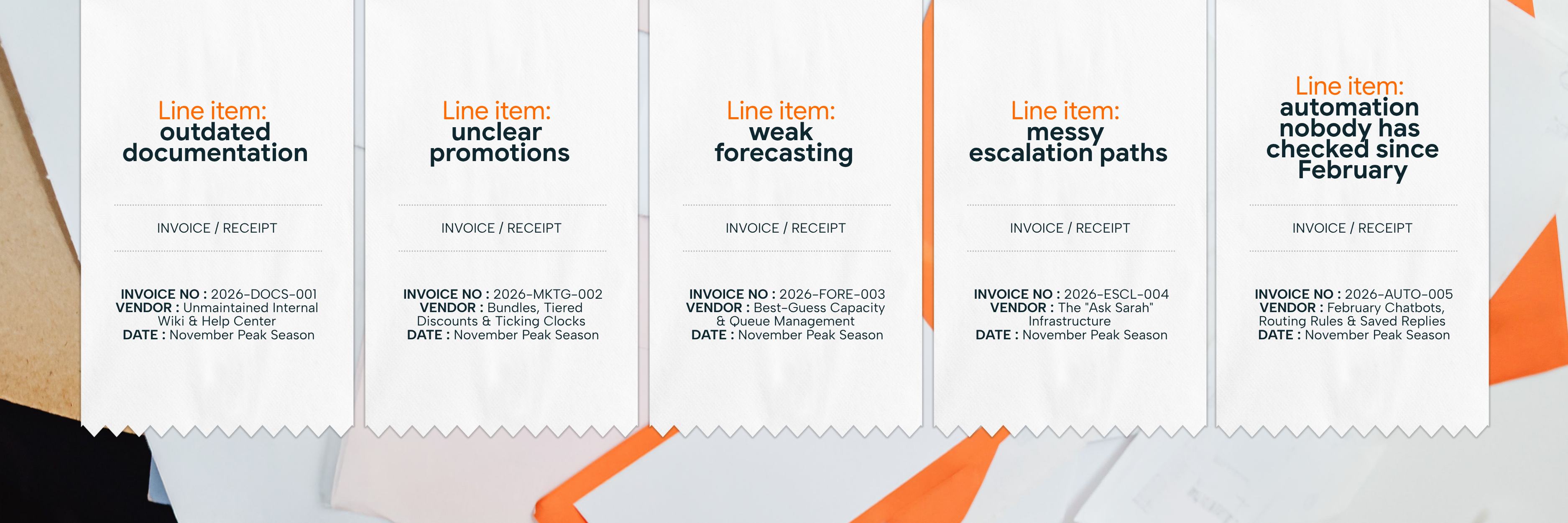
Line item: outdated documentation
In March, outdated documentation is annoying, but not necessarily catastrophic. During BFCM, the same documentation is suddenly supporting more customers, more team members, more automation, and potentially a group of people who were onboarded specifically to help with peak demand. Now the cost shows up everywhere.
New team members take longer to become confident when the source material they're learning from can't actually be trusted. And those gaps travel: experienced team members end up filling them in, customers get less consistent answers, and the same outdated information eventually finds its way into self-service and AI. You don't just pay for the bad document once; you pay every time somebody needs the information that should have been in it.
Line item: unclear promotions
Marketing has spent (at least) three months planning the BFCM campaign. There are bundles, tiered discounts, early-access codes, loyalty perks, free shipping above a certain threshold, and one offer that only applies to three products between 4PM and midnight for reasons nobody remembers.
The campaign goes live, and support finds out what half of it means from the customers.
During the rest of the year, a slightly confusing promotion might create a manageable bump in questions. During BFCM, when more people are shopping, promotions are changing quickly, and customers are already making decisions under a giant ticking countdown clock, confusion gets expensive fast.
Every unclear exclusion becomes a conversation, and every discount that doesn't apply the way someone expected becomes another. If support doesn't have the same information marketing does, those conversations take longer to resolve because the people answering them are trying to reverse-engineer the promotion in real time.
And some customers won't ask at all; they'll just abandon the purchase. You spent money getting them to the checkout, so it would be nice if everyone agreed on what happened once they got there.
Line item: weak forecasting
Being slightly understaffed on a random Tuesday is annoying. Being slightly understaffed when contact volume quadruples is how a queue acquires its own weather system.
Weak forecasting tends to hide particularly well because teams usually compensate for it pretty well. People stay late, managers jump into queues, lower-priority work gets pushed back. Everyone works a little harder and the week survives. Peak season removes most of that wiggle room.
If you underestimate demand, the obvious cost is capacity. But then come the less obvious ones: overtime, rushed hiring, compressed onboarding, experienced team members pulled away to help new ones, longer waits, lower quality, and increasingly tired people making increasingly expensive decisions.
And if your solution is to panic-hire once the problem is already obvious, you're paying to solve a problem several weeks after you needed the solution. Forecasting will never tell you exactly what November has planned for you, but it should at least stop November from being the first one to tell you you're short 20 people.
Line item: messy escalation paths
Almost every company has at least one process that works roughly like this: Ask Sarah. If Sarah doesn't know, Sarah knows who does. This is a functional system right up until Sarah is in a meeting, on PTO, asleep, or answering the other 46 people who have also discovered that Sarah is apparently critical infrastructure.
During peak season, unclear ownership gets expensive because complicated customer issues don't politely wait while your organization figures out whose problem they are.
Payment failures, lost orders, inventory discrepancies, damaged deliveries, unusual refund requests, and system outages can all require information from outside the support team. Without clear escalation paths, each one becomes a scavenger hunt. The customer experiences that scavenger hunt as silence.
Documenting who owns what, when something should be escalated, and how quickly the receiving team needs to respond is not particularly glamorous work. Neither is spending Black Friday asking a Slack channel, "Does anyone know who handles this?"
Pick your boring.
Line item: automation nobody has checked since February
Automation can remove an enormous amount of repetitive work during peak season. It can also remove an enormous amount of repetitive work incorrectly. BFCM is a particularly bad time to discover your chatbot has been confidently quoting a policy from March to several thousand customers.
The same applies to routing rules, order-tracking flows, IVR menus, automated emails, saved replies, and any other workflow you've trusted to keep doing its job while the business changed around it.
The annoying thing is that nothing has to be technically broken; your automation can be doing exactly what you asked it to do… six months ago, back when your policies, promotions, and customer journey looked different. Add BFCM volume and suddenly that small oversight has a much bigger audience.
The most expensive problems aren't always the obvious ones
When businesses calculate the cost of BFCM, there are plenty of obvious numbers to look at. Marketing spend. Discounts. Seasonal headcount. Overtime. Fulfillment. Shipping. Technology.
Operational inefficiency is harder to put neatly into a budget because the cost tends to hide inside other numbers. It could be:
- The preventable conversation your team still had to handle
- The customer who contacted you twice because the first answer wasn't clear
- The refund issued because nobody could confirm what had happened quickly enough
- The team member who spent half their shift answering questions that should have been documented
- The customer who reached checkout, couldn't understand the promotion, and disappeared
No single one of these is going to ruin Black Friday, but a few thousand of them can make it considerably less profitable. That's what makes operational debt so easy to ignore during the rest of the year. You're rarely handed one enormous failure with a convenient dollar amount attached. You lose a little time here, a little capacity there, a refund somewhere else. Then peak season helpfully consolidates the bill.
You don't pay the whole invoice in November
There is one small problem with calling BFCM “just one weekend”: your customers have absolutely no intention of respecting the name.
Everything they buy still has to be picked, packed, shipped, delivered, opened, tried on, assembled, gifted, exchanged, returned, refunded, or discovered behind the neighbor's recycling bin. That means the operational decisions you make before Black Friday can keep costing you well into December and January.
A vague return policy becomes much more problematic once thousands of holiday purchases are eligible for return at the same time. Poor tracking visibility follows customers right through the shipping rush. Weak documentation becomes a problem again when someone receives a gift they didn't buy and wants to know what on earth they're supposed to do with it.
Customers who had a bad experience in November don't magically forget about it because your BFCM banner came down. This is another reason treating peak season as a temporary capacity problem gets companies into trouble. You aren't staffing for a sale that begins on Friday and concludes on Monday; you're supporting the customer journey that sale creates, and that journey has a much longer tail.
The revenue might arrive in November, but a good chunk of the operational invoice arrives later.
Black Friday also gives you the receipt
So far, we've made BFCM sound a bit like a debt collector with a promotional calendar. There is an upside: it gives you an unusually concentrated view of where your operation is creating unnecessary work.
At normal volume, patterns can be easy to dismiss, but during BFCM, they're much harder to miss.
- If one question suddenly accounts for a huge share of your conversations, ask why customers needed to contact you about it at all
- If one escalation path became a bottleneck, find out where it stalled
- If an automation genuinely reduced contact volume, work out what made it successful
- If an automation created more work, resist the temptation to quietly turn it off and never speak of it again
Look at:
- The contact drivers that grew fastest
- The questions customers asked repeatedly
- The issues that took longest to resolve
- The reasons customers contacted you more than once
- The escalations that consistently got stuck
- The refunds and cancellations that could have been prevented
- The documentation your team searched for but couldn't find
- The automations that removed work and the ones that just moved it somewhere else
The point isn’t just documenting that “volume was higher than expected” or that “response times suffered”. You already know peak season is busy; the useful question is why each additional customer created the amount of work they did.
If 10,000 more orders automatically mean 10,000 more avoidable support conversations, that's worth knowing before you start planning how to handle 20,000 more orders next year.
Want an estimate before the invoice arrives?
You don't actually have to wait for BFCM to tell you where the gaps are.
Our BFCM Readiness Assessment takes about two minutes and looks across the six areas that tend to matter most during peak season.
At the end, you'll get a personalized readiness receipt showing what's in good shape, what needs attention, and what you might want to deal with before Black Friday adds it to the bill.