
An annual tradition, right up there with pumpkin spice and opening last year's readiness deck.
Every ecommerce company has the meeting. Not the fun one where Marketing shows mockups of the new holiday campaign or the one where the CEO orders pizza because morale is “really important right now." The one where everyone collectively realizes that BFCM has not, in fact, been cancelled this year.
Somebody shares a forecast; someone else points out it's probably a little too optimistic. Finance is pulling faces that suggest every additional headcount request causes them physical pain (understandable, considering that they’re the ones who shared that forecast).
CX politely explains that customers, rather inconveniently, still expect quick answers even during the busiest period of the year. The words "operational efficiency" are said at least nine times, because maybe repeating it enough will summon some?
As everyone in the room gets progressively sweatier, the greatest hits begin to play:
- "We'll just hire seasonal temps."
- "We've got AI now."
- "It's really only eight weeks."
- "We've survived every BFCM before."
Every single year, really smart people with years of experience gather in a room and repeat the exact same things that got them into huge amounts of trouble the year before. Then, sometime around January (after everyone's finally caught up on sleep), they say: "Next year, we'll start earlier." A classic.
It’s not that ecommerce leaders don't understand BFCM; they understand it perfectly well. We’ve just become really good at convincing ourselves that this year will somehow be different or better. Optimism as an operating model™.
In the interest of helping everyone avoid another post-BFCM retrospective called Lessons learned_FINAL_v8_FINAL (2).pptx, let's talk about some of the industry's favourite annual phrases. Not because the people saying these things are (necessarily) idiots, but because, if we're being honest, most of us have said at least three of them ourselves. Welcome to the support group; have a seat.
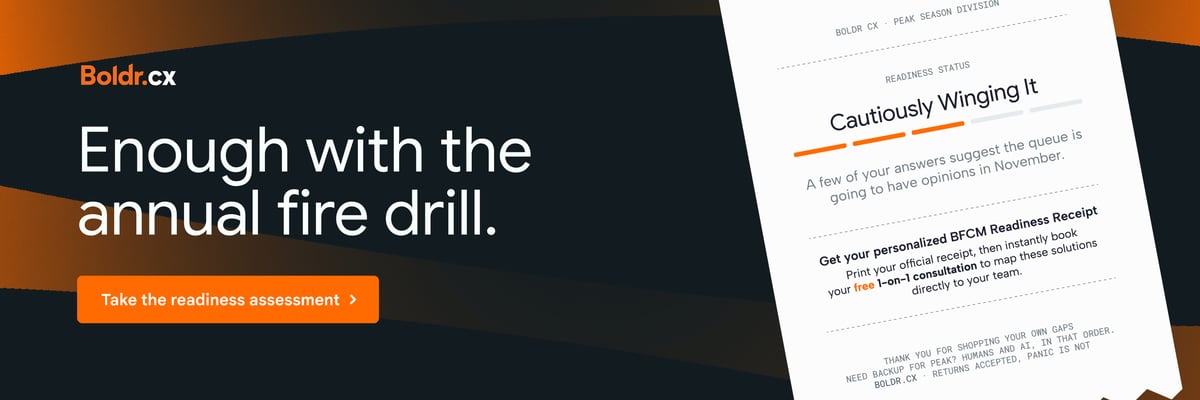
Small side quest: our BFCM Readiness Assessment takes about three minutes and gives you a personalized readiness receipt. Take it now, or bookmark it for when this article starts feeling a little too relatable.
.png?width=3750&height=1250&name=1%20(1).png)
1. "We only need help for eight weeks."
Translation: We've mistaken the busiest weeks for the entire job.
This one’s impressive because it's technically true: Black Friday and Cyber Monday are relatively short events… the same way a marathon is "just a run." Or moving house is "just putting things in boxes." And opening a restaurant is "just cooking food."
If you ignore absolutely everything that happens long before and after, then yes, it is only eight weeks. The issue with this mindset is that your customers don't experience your planning timeline; they experience the long tail of every shortcut that was taken to get ready in time.
They don't know your forecast got approved late. They don't know onboarding got squeezed into two weeks. They definitely don't know your knowledge base still contains screenshots from the platform you stopped using two years ago because updating it kept losing to projects with sexier names.
All they know is they've been waiting forty-three minutes for a chat reply about an order that's currently somewhere between "out for delivery" and "legally considered folklore."
By the time Black Friday arrives, the work should be largely finished (which, apparently, also has to fit into those mythical "eight weeks"). The forecasts should already exist, the workflows should already have been tested, the AI should already have failed safely in all the places it's likely to fail.
Seasonal hires shouldn't be learning your products while customers are actively rage-smashing the “buy” button. Your experienced people shouldn't be explaining the returns policy for the fifteenth time before lunch because somebody forgot to update the documentation after last quarter's policy change.
Peak season isn't where you build your operation; it's where you find out whether you've built a good one.
.png?width=3750&height=1250&name=2%20(2).png)
2. "We'll just hire seasonal temps."
Translation: We've confused recruitment with readiness.
This one gets said with the confidence reserved for people announcing they've "sorted the holiday shopping." As if the actually difficult part of Black Friday is locating human beings who are willing to answer customer questions.
Let’s be so for real: just “hiring people” isn't very hard. LinkedIn exists, recruiters exist, and people, generally speaking, enjoy earning money. Piece of cake. Go ahead and do that.
Congratulations! You've successfully acquired humans! Now they need to understand your products, your policies, your promotions, your systems, your tone of voice, your customer expectations, and the seventeen edge cases everyone forgets about until they're happening two hundred times a day.
They also need to know which policy is the actual policy, because the knowledge base says one thing, the training deck says another, and somewhere in Slack there's a message explaining why neither of those applies to customers who ordered through the mobile app. Nobody remembers which Slack channel.
Have you solved the staffing problem by putting people in seats? Technically. You haven't solved the readiness problem. Customers don't care whether the person helping them started last Tuesday or last decade. They don't think, "Well, this answer was wrong, but in fairness, it's Dave's second shift." They remember whether your brand knew what it was doing.
Peak season doesn't give you extra credit for trying; it grades you on execution. That's why we shouldn't build our BFCM strategy around seasonal hiring, but around a team that already knows the business inside and out. Then add capacity around that foundation.
This team knows how the business makes decisions. They know when an exception makes sense, when something feels off, and when the knowledge base hasn't caught up with reality yet. This is the sort of judgement you can't compress into a two-week onboarding programme, no matter how many awkward Loom videos you record.
Every autumn, we take our strongest operators, remove them from the frontline during the busiest period of the year, and instead, ask them to teach dozens of new people everything they've learned over the last twelve months... in roughly the time it takes to binge a really good Netflix series.
Then we're surprised when quality gets shaky. Seasonal hiring as a general concept isn't the problem; expecting seasonal hiring to replace or quickly adopt deep operational knowledge is.
.png?width=2880&height=960&name=3%20(2).png)
3. "We've got AI now."
Translation: We've promoted the chatbot to Head of Support.
This sentence is usually delivered with enormous confidence, as though somebody has just announced the invention of electricity. "We've got AI now." Fantastic. You've also got email? Neither is an operating model.
We genuinely love AI. Used properly, it's one of the most useful things to happen to customer experience in years. It can take repetitive work off your team's plate and answer very common questions in seconds. That's awesome. It also has absolutely nothing to do with the conversations that tend to make BFCM... well, BFCM.
Peak season tends to produce customers who don't sit pretty in a perfect flowchart. Their discount code didn't work because they bought through Instagram but checked out on desktop. Their package says it was delivered, but unless their house has changed color overnight, something's off… and a million other edge cases. These are not the moments where customers need a chatbot; they need your operation to make sense.
Your experienced support people have always been compensating for operational gaps. They know the knowledge base is out of date, so they check Slack. They know Product changed the returns policy but never updated the documentation, so they answer from memory. They know the workaround because they were in the meeting where the workaround became the workaround.
AI doesn't know any of that, nor should it; it reads only what you give it. It can’t magically fix confusing policies, contradictory documentation, or workflows held together by optimistic thinking. So when the chatbot proudly serves up an article that should have been archived six months ago, that's a documentation problem and a documentation problem only.
The same goes for handoffs. Nothing reveals the quality of your customer journey faster than the moment your chatbot says, "Let me connect you with a member of our team."
Cool. What happens next? Does the customer have to repeat everything they just typed? Does the team member have the context they need? Is the issue routed to the right place? Can someone actually solve it, or are they about to spend the next hour bouncing between departments like a Roomba trapped under a coffee table?
None of these questions have anything to do with the AI; they're purely operational. And BFCM has the nastiest ability to ask all of them at once. So yes, use AI, knock yourself out. Just don't ask or expect it to compensate for problems you've spent the rest of the year ignoring. The quality of your AI is usually a reflection of the quality of your operation.
.png?width=3750&height=1250&name=4%20(2).png)
4. "Outsourced teams won't know our brand."
Translation: We've confused payroll with operational knowledge.
This objection has always fascinated us because it sounds sensible until you think about it for more than thirty seconds.
Let's play it out. Imagine you hire twenty seasonal support folks internally next month. Do they automatically know your brand because HR issued them a company email address? Do they instinctively understand your tone of voice because their laptop has your logo on it? Do they absorb six months worth of product knowledge through osmosis during onboarding?
No; if they did, every onboarding manager could retire tomorrow. People know your brand because somebody taught them. They've been coached, they've received feedback. They've learned the products, the policies, the exceptions, and, maybe most importantly, the judgement behind them. They've had time to understand why your business makes certain decisions, not just what those decisions are.
That's what customers notice, not where on Earth the person answering the email parks themselves every morning. No customer has ever ended a support conversation thinking, "Well, they solved my problem quickly, explained everything clearly, and were genuinely helpful... but I have a sneaking suspicion they're in… Canada!!!, so one star." They remember whether your brand showed up when it mattered and that's it.
It won't be everyone's favorite observation, but this objection often says more about the business than it does about outsourcing. If your concern is that an external team could never understand your brand, it's worth asking this: how easy have you actually made your brand to learn?
Is your documentation up to date? Do your quality standards clearly explain what "good" looks like? Can someone new understand how decisions get made, or are they expected to learn by asking whoever's been around the longest?
If the only way to become good at supporting your customers is to spend twelve months sitting next to your best-performing team member, then they aren't your competitive advantage; they're your contingency plan. A very risky place to keep all of your institutional knowledge. Give them a break.
Great outsourcing relationships work because they're built on the exact same things that make internal teams successful: good documentation, clear coaching, thoughtful onboarding, and an operating model that doesn't depend on institutional knowledge living inside a handful of people's heads. Payroll and location have very little to do with it.
Customers don’t leave saying, "Yeah, that was truly a fantastic reporting structure." They leave remembering the general experience they had.
.png?width=3750&height=1250&name=5%20(1).png)
5. "Our biggest problem is volume."
Translation: We're blaming the loudest symptom.
When your ticket volume triples overnight, it feels fairly reasonable to conclude that... well... your biggest problem is ticket volume. It's a bit like saying your biggest problem during a house fire is all the smoke. Technically, while you're standing in it? Fair enough. But the smoke isn’t what’s burning your house down.
Volume gets blamed for all sorts of things it didn't actually cause: longer handle times, more escalations, lower CSAT, lower response times, frazzled team members, customers asking why their order appears to have taken a holiday in another state. Those things absolutely happen during BFCM, but not because of volume.
Volume doesn't make your documentation out of date, volume doesn't invent confusing policies, volume doesn't decide that the chatbot should answer a question using an article last updated by someone whose exit interview is old enough to vote. Volume just removes your team's ability to work around all those problems.
During the rest of the year, your best people always save the day; peak season removes that luxury. When one person is only juggling three conversations, they might have time to hunt around and piece the answer together. When they're juggling thirty? Not so much.
That's why we get a little nervous when someone says, "Our biggest challenge is volume." Volume is nothing but the moment your operation runs out of spare capacity to compensate for itself. It's the operational equivalent of turning the lights on after a massive party with too much booze involved; you're not creating the mess at that very moment, but you are finally seeing it.
Every brand gets more customer questions during peak season; the difference is how many of them could have been prevented in the first place by making sure:
- The knowledge base is current.
- The policies are clear.
- AI knows when to step aside.
- Team members aren't improvising because they don't have to.
Reducing the number of problems that volume can amplify way before it triples (or more) is a much more interesting strategy than just trying to “answer more tickets faster”.
.png?width=3750&height=1250&name=6%20(1).png)
6. "We've survived every BFCM."
Translation: We've confused survival with success.
This one gets a special place in the ecommerce hall of shame, mostly because "we survived" is such an incredibly polite way of describing what actually happened.
What it means is, "The queues peaked at eight hours, RevOps briefly became a support team, three managers answered tickets until 3AM for a week, we panic-refunded so many orders that Finance still greets us like an ex at the grocery store, and the warehouse folks have requested that nobody ever mention November again. But yes, technically, we survived."
Survival is a really crappy benchmark. You've survived every dentist appointment you've ever had, that doesn't mean you're super stoked to book another one. Whether you “survived” peak season is obvious; whether next year will look any different at all is the part that matters.
Every BFCM leaves behind a huge amount of operational intelligence. You discover which policies confuse customers, which AI journeys fall apart under pressure, where your forecasts were too optimistic, which workflows created unnecessary effort, and where your team members had to rely on judgment instead of systems.
That's incredibly valuable information… assuming you do something with it. Unfortunately, many companies treat their BFCM retrospective the same way most people treat their New Year's resolutions.
There's a meeting. Everyone agrees on what needs to change, makes notes, and action items are assigned. Then life happens (rude), suddenly it's September again, someone opens last year's presentation, changes the year in the title, and everyone's absolutely delighted to discover they're about to solve exactly the same problems all over again.
BFCM shouldn't be something to recover from; it should be treated as the most honest operational audit you'll get all year.
.png?width=3750&height=1250&name=7%20(1).png)
7. "We'll deal with it later."
Translation: Future Us seems to have an incredible amount of free time.
Future Us is absolutely amazing.
Future Us finally updates the knowledge base. Future Us cleans up the chatbot, redesigns the workflows, gets really serious about QA, and somehow finds the time to overhaul onboarding while they're at it. Honestly, Future Us is carrying this entire industry on its gorgeous, muscly shoulders.
Unfortunately, Future Us always, inevitably, becomes... us. And we're busy. Not lazy, not incompetent. Just busy.
There's another product launch, another campaign, another migration. Sales wants new enablement materials even though nothing has changed, because of course they do. Marketing has a launch date that definitely isn't moving, because of course it isn't. Meanwhile, in the corner of your task management system sits a ticket called "Update returns documentation," celebrating its first birthday. Yay.
Operational improvements almost never get straight up rejected. Nobody says "No thanks, we'd actually prefer confusing documentation." They just keep slipping down the priority list because there's always something louder demanding attention.
Until one day, someone points out that BFCM is only a couple of months away. Now the conversation changes. Nobody wants to redesign workflows in November. Nobody wants to retrain a team while order volumes are doubling. Nobody wants to discover on Cyber Monday that the chatbot has interpreted your returns policy as some kind of sick creative writing exercise.
Once peak season is already in sight, you're out of time and from there, the best you can do is keep the operation mostly upright until the dust settles. Again.
That's why so many of the same problems become visible again every year; not because businesses don't know they're there, but because they only become impossible to ignore once there's no longer enough time to fix them properly.
If you think about it, every objection we've talked about is really just a different way of trying to make BFCM feel much smaller than it is. It's only eight weeks, we'll hire more people, AI will handle it, we'll sort it out afterwards…
We get it; tinier things are less scary by default. Unfortunately, calling a Doberman a Chihuahua won’t make the dog smaller in real life the same way that saying that something is an eight-week problem won't stop it from actually being a six-month one.
All of these excuses are built on the same assumption: peak season is a temporary event that needs a temporary solution. That's probably the biggest misconception of all: BFCM isn't the thing you're preparing for; it's the thing you're preparing through.
Every year, it puts your operation under more pressure than almost any other period on the calendar, and that's exactly why it's so valuable. For a few weeks, your operation becomes completely honest: it’s a free stress test of the way your business works.
Do you think you're ready to go? We genuinely hope you're right. We also built a (free, no strings attached) BFCM readiness assessment because hope has a questionable track record as an operational strategy.
Answer a few questions, and we'll generate a personalized receipt showing what's ready for peak season, what isn't, and what deserves your attention before BFCM gets there.
Related posts
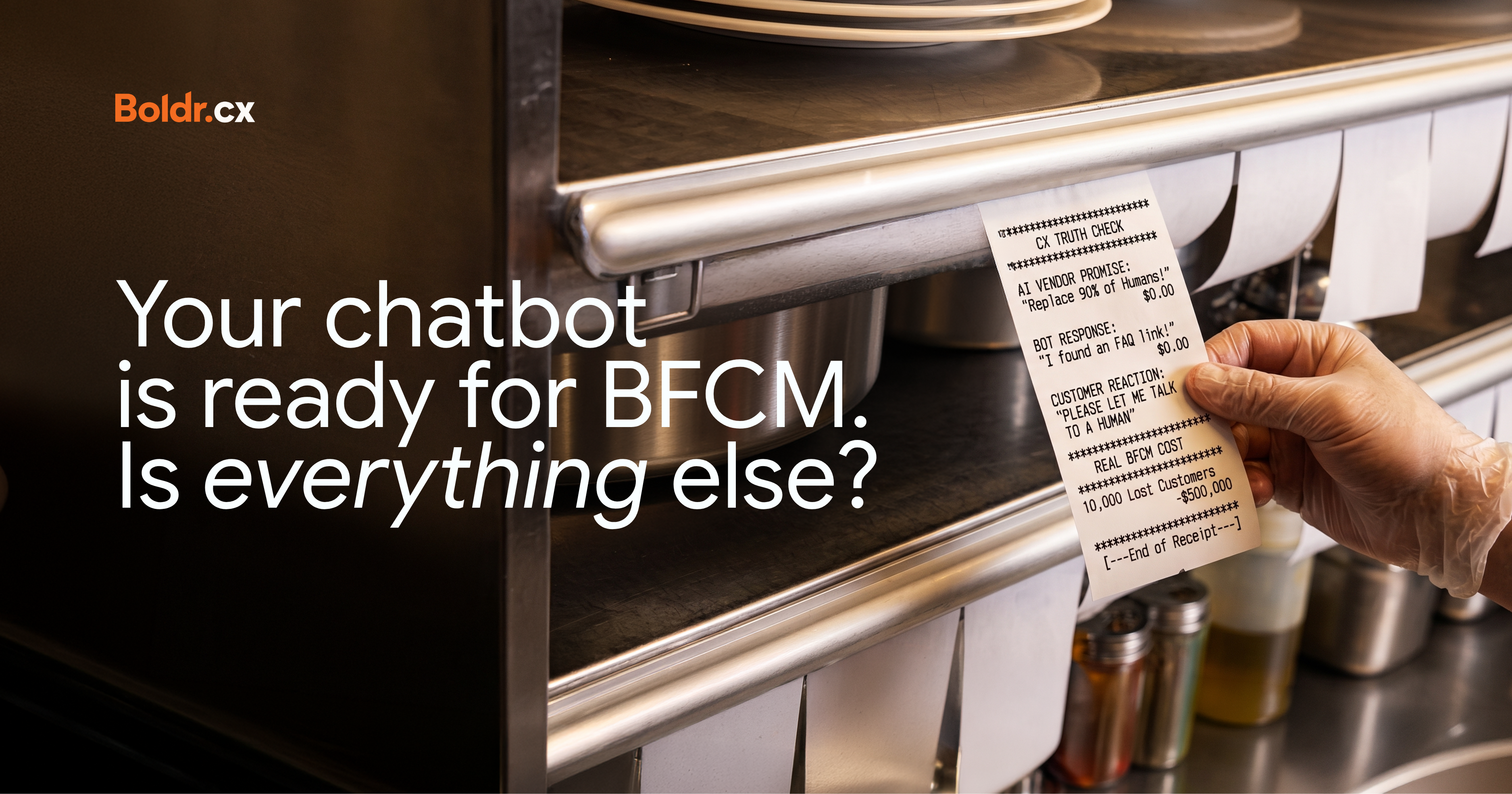
Your chatbot is ready for BFCM. Is everything else?
Your chatbot might be ready for BFCM, but is the operation behind it? Here’s where AI helps, where humans matter, and what peak season will expose.

Why growth exposes CX weaknesses faster than any other function
Growth has a funny way of making companies feel wildly successful and deeply shaky at the same time.
The peak season readiness playbook
A practical 12-week BFCM readiness guide to help you prepare your customer support operation, find gaps early, and make peak season considerably less exciting.