Ecommerce customer service best practices for high-growth brands
Ecommerce CX isn’t just support, it’s a revenue protection function.
High-growth brands face structural challenges generic advice doesn’t usually address: WISMO floods, seasonal volume spikes, return complexity, and post-purchase expectations that brand marketing created.
Here’s a practice framework built for scale, not just customer satisfaction scores.
What makes ecommerce CX structurally different
A lot of customer service advice falls apart the second you apply it to a fast-growing ecommerce brand.
“Respond quickly” is helpful in theory. But it doesn’t solve the reality that your support volume can spike 4x in a week because a carrier network melts down during Black Friday. It doesn’t solve the operational chaos that happens when marketing launches a campaign without warning CX. And it definitely doesn’t solve the flood of customers refreshing tracking links every six minutes asking where their package is.
Ecommerce customer service strategy has to account for something most generic support advice ignores: the majority of support demand is operationally predictable.
Customers usually aren’t contacting ecommerce brands because they’re confused about the product. They’re contacting support because something in the post-purchase experience created uncertainty.
Maybe tracking updates stopped moving, maybe a return disappeared into a warehouse black hole, maybe delivery expectations were never communicated clearly in the first place.
That changes how ecommerce CX operations should be designed.
Post-purchase is where most tickets live
For many DTC brands, the highest-volume customer interactions happen after checkout.
That matters because most brands still invest disproportionately in pre-purchase optimization while treating post-purchase support as a reactive function sitting somewhere off to the side. In reality, post-purchase experience is where trust either compounds or collapses.
A customer who experiences confusing shipping communication, inconsistent support answers, or a frustrating return process doesn’t just become a support issue, they become a retention issue.
This is one reason high-growth ecommerce brands eventually need tighter alignment between CX, fulfillment, logistics, and retention teams. Support isn’t separate from the customer journey. It’s one of the clearest reflections of how operationally healthy the business actually is.
WISMO and shipping inquiries as a volume driver
WISMO (“Where Is My Order?”) is one of the defining operational realities of ecommerce support at scale.
For many brands, it becomes the single largest ticket category during peak periods. But the important thing about WISMO is that it’s often misunderstood as purely a staffing problem.
Usually, it’s an information problem. Customers reach out because shipping updates lag behind reality, delivery expectations were unclear, or carrier disruptions happened silently. That means adding more frontline support capacity often treats the symptom instead of the cause.
Example 1: proactive communication reduces inbound volume
One ecommerce brand reduced WISMO volume by 35% after implementing proactive SMS delay notifications during carrier disruptions. Headcount didn’t change. The information flow did.
That’s why proactive customer service in ecommerce matters so much. The best support teams don’t just answer questions faster, they reduce the need for customers to ask them in the first place.
Returns and exchanges as a loyalty lever, not just a cost
A surprising number of ecommerce brands still treat returns primarily as operational damage control.
Customers experience them differently. To them, returns are part of the buying journey. A frustrating return process can undo an otherwise positive purchasing experience incredibly quickly.
This becomes especially important in categories like apparel, beauty, wellness, and subscription products where repeat purchase behavior matters. In those environments, ecommerce returns management support is directly connected to retention.
The brands that handle returns well usually focus less on policy enforcement and more on clarity, visibility, and expectation-setting. Customers can tolerate a slower process much more easily than an unpredictable one. That distinction matters operationally because uncertainty creates support volume. Visibility reduces it.
The ecommerce ticket taxonomy (and why it matters)
One of the biggest mistakes ecommerce brands make is treating all support tickets as operationally equal. They aren’t.
Different ticket categories create completely different demands on staffing, automation, escalation handling, and channel design. A billing issue behaves differently from a delayed shipment. A checkout bug requires a completely different response structure than a return request.
Understanding your ticket taxonomy makes workforce planning and escalation management dramatically easier. It also reveals where proactive communication can eliminate entire categories of preventable inbound volume.
Ecommerce ticket taxonomy
|
Ticket category |
Typical % of volume |
Deflection potential |
Complexity |
Typical SLA target |
|
WISMO / shipping status |
25–40% |
High |
Low |
Minutes |
|
Returns and exchanges |
15–25% |
Moderate |
Medium |
Hours |
|
Order changes / cancellations |
5–15% |
Low |
Medium |
Fast turnaround required |
|
Product questions |
10–20% |
Moderate |
Medium |
Hours |
|
Billing and payment issues |
5–10% |
Low |
Medium to high |
High priority |
|
Technical checkout issues |
2–8% |
Low |
High |
Immediate escalation |
|
Subscription management |
5–15% |
Moderate |
Medium |
Hours |
Request a CX readiness review
If your ecommerce support operation feels increasingly reactive during growth periods, the issue may not just be staffing, it may be the operational structure underneath it. Let’s chat about it, we can help!
Proactive CX: reducing inbound by fixing the information gap
A lot of ecommerce support volume is preventable. Not because customers are unreasonable, but because the experience leaves too many unanswered questions between checkout and delivery.
High-growth brands eventually realize that proactive communication is one of the most effective forms of volume reduction available. Not as a “delight” tactic, but as operational strategy.
Shipping notifications and delay alerts
Most ecommerce brands already send shipping confirmations. Far fewer send useful shipping communication. Customers don’t necessarily want more notifications. They want accurate expectations. Especially during disruptions.
A proactive delay alert often prevents multiple inbound contacts because it answers the emotional question underneath most WISMO tickets:
“Did something go wrong with my order?”
Good communication acknowledges the issue clearly, explains what changed, and gives the customer a realistic expectation for what happens next. Vague “we’re looking into it” messaging usually creates more tickets, not fewer.
This is also where AI-enabled CX can become operationally useful instead of gimmicky, particularly for automated shipping communication and status workflows.
Return status automation
Returns create an enormous amount of unnecessary support demand simply because visibility disappears after the customer ships the item back.
Most ecommerce brands communicate heavily during fulfillment, then go strangely quiet during the return process itself. That silence creates uncertainty, and uncertainty creates tickets.
Customers want visibility into whether the return was received, inspected, approved, or refunded. Without that transparency, they start reaching out manually for updates.
Good return automation doesn’t just improve efficiency. It reduces anxiety throughout the post-purchase journey.
Order confirmation flows that set expectations
A surprising amount of ecommerce support demand starts with assumptions customers didn’t realize they were making.
Marketing says:
“Fast shipping.”
Customers hear:
“Amazon-level logistics.”
The order confirmation flow is one of the best opportunities to reset operational expectations clearly before frustration develops, especially during launches, preorder windows, or peak season fulfillment constraints.
Brands that communicate proactively during those moments usually survive growth spikes much more cleanly than brands relying on reactive support after customers become frustrated.
Peak season scaling: what breaks and how to prevent it
Peak season exposes every operational weakness simultaneously.
Forecasting assumptions fail. Shipping timelines slip. Ticket queues spike. New seasonal hires ramp too slowly. Internal documentation becomes outdated almost overnight.
The problem is rarely the volume itself. It’s that most ecommerce support operations are designed around average demand instead of surge conditions.
Flex staffing and outsource burst capacity
One of the biggest mistakes high-growth brands make is trying to permanently staff for peak demand. That usually creates inefficiency in the other ten months of the year.
A more sustainable approach combines stable internal operations with flexible burst capacity during periods of extreme demand. This is where outsourced ecommerce support can become strategically valuable, particularly for high-volume Tier 1 interactions like WISMO and returns.
Brands that scale well operationally usually have predefined surge staffing plans before Q4 arrives, not during the middle of it. This also ties closely to ecommerce staffing capacity for peak season and forecasting queue behavior accurately during growth periods.
And for brands needing scalable frontline support quickly, this becomes a strong use case for ecommerce CX support models.
Knowledge base sprint before peak
One of the least glamorous but highest-impact ecommerce CX practices is updating operational knowledge before volume spikes hit.
Peak season breaks outdated documentation incredibly fast. Shipping exceptions change, fulfillment timelines shift, and promotions create edge cases nobody documented properly. Suddenly, support teams are improvising answers in real time.
Example 2: peak season quality drift
One ecommerce brand saw CSAT drop by nearly a full point during Q4 because support teams were still using outdated shipping exception messaging after fulfillment timelines changed. A short knowledge sprint before peak season would likely have prevented most of the issue.
This is also why onboarding seasonal support team members quickly becomes operationally critical during growth periods, and why formalized training systems become increasingly important as ecommerce support complexity grows.
SLA tiering during surge
One operational reality many brands avoid acknowledging is that not all tickets should receive the same urgency during extreme volume periods.
A payment issue usually carries higher customer risk than a minor shipping preference change. Mature ecommerce support organizations recognize that and temporarily prioritize workflows accordingly.
That doesn’t mean lower-priority customers are ignored. It means operational resources are allocated intentionally instead of evenly. During peak periods, equal prioritization often creates worse outcomes for everyone.
Peak season CX readiness checklist
Before peak season begins, ecommerce brands should validate:
- staffing forecast assumptions
- surge escalation paths
- shipping exception documentation
- return policy visibility
- carrier communication workflows
- knowledge base updates
- seasonal onboarding readiness
- SLA prioritization rules
- refund escalation ownership
- proactive delay messaging templates
Channel design for ecommerce brands
A lot of ecommerce brands accidentally create support chaos by adding channels reactively instead of designing them intentionally.
Just because customers can contact you everywhere doesn’t mean every channel should function identically. Live chat, for example, tends to work best for quick transactional workflows and pre-purchase clarification. Email usually handles more documentation-heavy issues like returns or escalations. Social channels often operate more like public escalation environments than true support channels.
The right mix depends heavily on customer behavior, order complexity, operational maturity, and brand positioning. This is one reason structuring your ecommerce CX team for growth matters so much operationally.
And for DTC brands especially, channel design usually requires tighter coordination between support, fulfillment, and retention teams than traditional support models account for.
Returns as a retention strategy
A lot of ecommerce brands still think about returns primarily as margin erosion. Customers think about them as trust signals.
A painful return process creates hesitation around future purchases, especially in categories where fit, experimentation, or subscription behavior matter. The strongest ecommerce CX teams understand that returns influence customer confidence long after the refund is complete.
That doesn’t mean every return should become frictionless regardless of risk. It means the process should feel predictable, visible, and fair enough that legitimate customers don’t feel punished for uncertainty.
The brands that handle returns well usually see stronger repeat purchase confidence because customers trust the post-purchase experience, not just the product itself.
Metrics that matter specifically for ecommerce CX
A lot of ecommerce brands track generic support metrics without asking whether they actually reflect operational health.
For ecommerce specifically, some of the most useful indicators are:
- WISMO volume trends
- repeat contact rates
- return-related satisfaction
- refund turnaround time
- backlog recovery speed during surge periods
Those metrics often reveal more about customer friction than generic response-time reporting alone. This ties closely to the broader question of which CX metrics actually matter operationally versus cosmetically.
And as support complexity grows, formalized QA and coaching systems become increasingly important for maintaining consistency during high-volume periods.
Final thoughts
High-growth ecommerce CX is fundamentally an operational scaling problem.
The brands that handle growth well usually aren’t the ones answering tickets fastest. They’re the ones reducing avoidable friction before customers need support in the first place.
That means:
- clearer expectations
- stronger post-purchase communication
- scalable staffing models
- intentional escalation design
- operational readiness before peak periods arrive
Because once volume spikes hit, every hidden weakness becomes visible very quickly.
The good news is that most ecommerce CX problems are predictable. Which means they’re also fixable.
Talk to us about ecommerce CX outsourcing
Ecommerce support FAQs
What are ecommerce customer service best practices?
The best ecommerce customer service practices focus on proactive communication, scalable staffing, clear return workflows, and reducing preventable inbound demand like WISMO tickets.
How do I reduce WISMO tickets?
Improve shipping visibility through proactive notifications, delay alerts, realistic delivery expectations, and better tracking communication.
How should I handle returns at scale?
Create clear workflows, automate status communication, and design returns as part of the customer experience instead of treating them purely as operational cost.
How do I scale customer support for peak season?
Use flexible staffing models, prepare knowledge systems before peak periods, and prioritize high-impact ticket categories operationally.
What channels should an ecommerce brand support?
That depends on customer behavior and operational complexity, but most brands benefit from a mix of chat, email, and selective social support.
What metrics matter most for ecommerce CX?
WISMO volume, repeat contact rates, return-related satisfaction, refund turnaround time, and escalation rates are often more useful than generic response-time metrics alone.
Should I outsource ecommerce customer service?
For many high-growth brands, outsourcing Tier 1 volume support creates flexibility during surge periods while allowing internal teams to stay focused on complex or strategic work.
How do I build a proactive CX strategy?
Focus on reducing uncertainty through better communication, automated updates, realistic expectation-setting, and visibility throughout the post-purchase journey.
Related posts
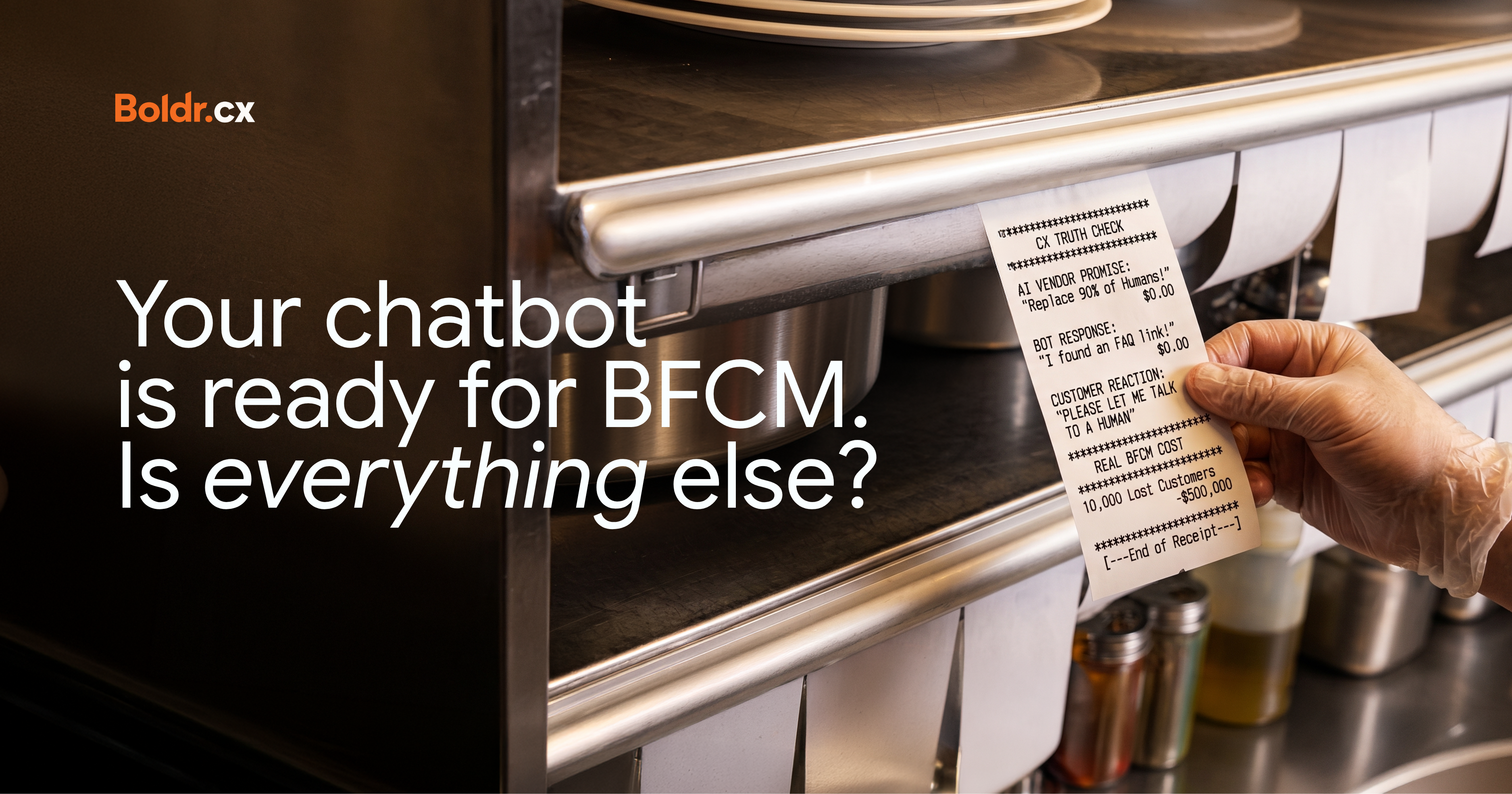
Your chatbot is ready for BFCM. Is everything else?
Your chatbot might be ready for BFCM, but is the operation behind it? Here’s where AI helps, where humans matter, and what peak season will expose.
Why BPO partnerships fail (and how to avoid the most common traps)
Think your BPO failed because of the vendor? Maybe. But most outsourcing failures start earlier. Here’s what actually goes wrong and how to avoid it.
Channel orchestration without chaos: building omnichannel CX that actually works
Customers experience one relationship. Most companies manage six disconnected systems. Here's how to build omnichannel CX that actually works.